If your building is taller than six stories, Local Law 11 (the FISP) requires a close-up façade inspection every five years and specific remedial actions if the façade is rated Unsafe. Buildings receive one of three ratings: Safe, Safe with a Repair and Maintenance Program (SWARMP), or Unsafe. An Unsafe rating means the owner must install public protection immediately and complete repairs within the specified period as required by law. The first move is simple: confirm your filing status and cycle deadline in DOB NOW: Safety.
TL;DR:
- Buildings taller than six stories must have façade inspections every five years, with immediate public protection measures required for Unsafe ratings.
- Only trained, licensed QEWI professionals can conduct inspections, requiring close-up access and detailed defect documentation.
- Unsafe ratings trigger urgent repairs and public sidewalk protections, with deadlines limited by filing and extension requests to avoid penalties.
- Proper documentation, including photographs and signed reports, is essential for repairs and to prevent prolonging unsafe conditions or fines.
- Boards should proactively plan for inspections, budget repair costs, and keep thorough records to avoid rushed repairs or negative impacts on sales and financing.
Table of Contents
- What Local Law 11 (FISP) covers and which buildings must comply
- Who performs inspections: QEWI qualifications and the inspection process
- Façade condition ratings and required owner actions
- Deadlines, filing mechanics and DOB NOW: Safety practical steps
- Penalties, extensions and cost considerations
- Practical checklist and board-ready action plan
- Detailed overview of repair and maintenance standards following inspections
- Common types of façade defects identified during inspections and their implications
- Historical context and evolution of Local Law 11 regulations
- Role and responsibilities of contractors and engineers in the repair process
- Common pitfalls boards run into with facade compliance
- How Michael J. Carroll helps you navigate façade issues in a sale or purchase
- Sources
- FAQ
What Local Law 11 (FISP) covers and which buildings must comply
Local Law 11, formally the Façade Inspection Safety Program, requires owners of buildings taller than six stories to have their exterior walls examined by a licensed professional on a recurring cycle. The legal basis sits in NYC Administrative Code §28-302.1 and Title 1 of the Rules of the City of New York §103-04, which together define who must file and how the inspection must be conducted.
The requirement is tied to a five-year critical examination cycle, and the Department of Buildings assigns each qualifying building to a subcycle based on its borough and the last digit of its block number. That subcycle determines your filing window, not the calendar year alone.
Before assuming your building is compliant or overdue, a board should:
- Confirm the building’s exact subcycle and filing deadline on DOB’s façade filing status pages.
- Check whether any prior report was rejected, marked late, or flagged as “No Report Filed.”
- Review the most recent technical report, if one exists, for outstanding SWARMP items carried into the current cycle.
Who performs inspections: QEWI qualifications and the inspection process
Only a Qualified Exterior Wall Inspector, known as a QEWI, can file a FISP technical report. This is a licensed architect or engineer who meets specific DOB experience and examination criteria, and no other professional designation substitutes for it.
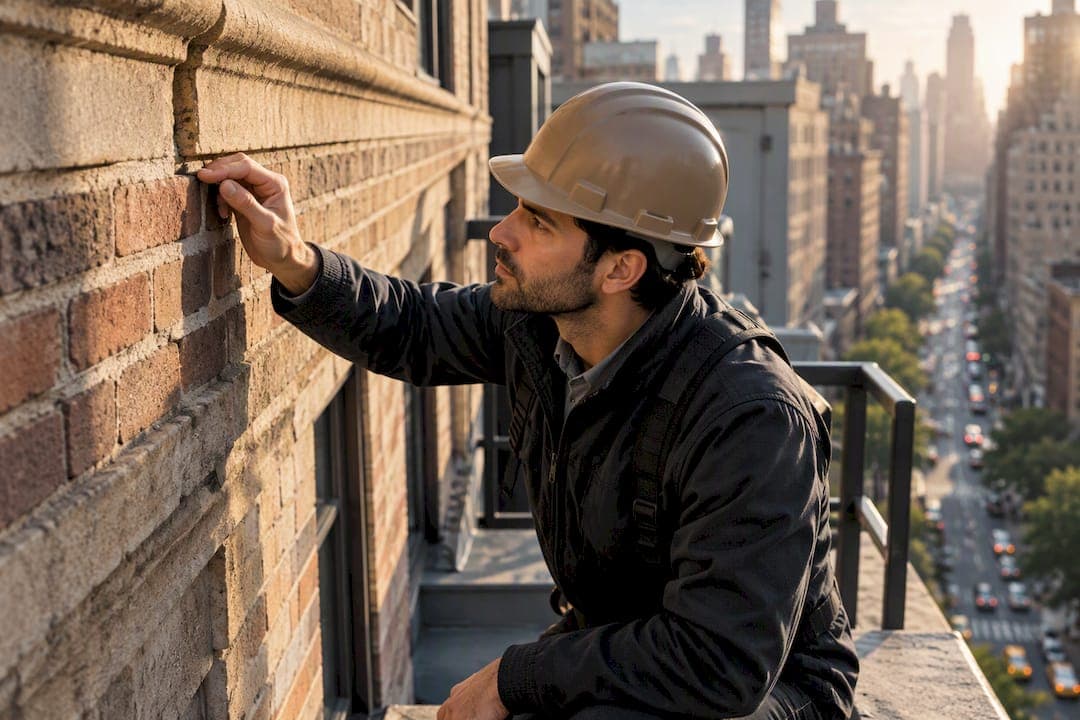
The inspection itself follows a defined standard. A close-up, hands-on examination is required at intervals not exceeding 60 feet along any public right of way, a rule strengthened in the 2020 Façade Rule revision to increase inspection rigor. Binoculars and photographs from the ground are not a substitute for physical access to the wall.
A board hiring a QEWI should require, at minimum:
- A written scope confirming close-up access methods (scaffold drop, boom lift, or rope access).
- Dated, annotated photographs of every defect identified, keyed to a façade elevation drawing.
- A written list of recommended repairs with rough sequencing and urgency.
- A draft report reviewed with the board before filing, so questions get resolved before the report becomes a matter of public record.
Façade condition ratings and required owner actions
Every FISP report ends in one of three ratings. Safe means the façade needs no immediate work beyond routine maintenance. SWARMP means the façade is stable but carries a documented condition that needs ongoing monitoring or a maintenance program until the next cycle. Unsafe means a condition poses a threat to public safety and demands action now.
An Unsafe rating triggers a specific sequence, as laid out on the DOB façade safety page:
- Public protection, typically a sidewalk shed or netting, must go up immediately to protect pedestrians.
- A FISP3 unsafe notification is filed with the report.
- Repairs must be completed within a specified period after the technical report’s filing date, as required by applicable regulations.
- An amended report confirming the correction must be filed promptly after the repair, which is what allows the shed to come down.
SWARMP conditions can’t be carried forward indefinitely. A condition reported as SWARMP in one cycle generally cannot be reported as SWARMP again in the next cycle without resolution, since DOB expects the maintenance program to actually close out the issue.
Pro Tip: Ask your QEWI to flag any SWARMP item that’s already appeared in a prior report. If it’s been carried twice, budget for the repair now rather than waiting for it to become Unsafe.
Deadlines, filing mechanics and DOB NOW: Safety practical steps
Filing runs on a straightforward sequence: confirm your cycle window, engage a QEWI, receive the technical report, then file it through DOB NOW: Safety, the portal that has replaced older paper filing routes.
Two filing types matter beyond the standard technical report. A FISP3 notification is required the moment a condition is rated Unsafe. FISP1 and FISP2 extension requests are used when a building needs more time, either to complete the inspection itself or to finish repairs, and these must be filed before the existing deadline lapses, not after.
Cycle 10 introduced a wrinkle worth knowing: certain subcycles gained conditional early filing options, with provisional acceptance requiring payment within 10 business days, a detail covered in the Cycle 10 service notice.
Before submitting, a board should have on hand:
- The QEWI’s signed and sealed technical report.
- Dated photographic evidence of any completed repairs.
- Proof of payment for filing fees, since provisional filings lapse without it.
- A copy of the prior cycle’s report for continuity if any SWARMP items carried forward.
Penalties, extensions and cost considerations
Civil liability for an Unsafe condition generally begins after a set period from the technical report filing, unless the owner has secured an approved extension. Gaps between expiring extensions and new filings are where penalties accumulate fastest, since DOB does not pause enforcement while paperwork is pending.
Extensions have limits. FISP1 and FISP2 requests can push a deadline, but they cannot extend past the completion date DOB assigns for correcting an Unsafe condition. A building flagged “No Report Filed” accrues monthly civil penalties until a report is filed, which is why an early initial filing, where eligible, can be a useful way to stop the clock.
Buildings should budget in three buckets: the inspection fee itself, sidewalk shed or netting rental for the duration of any repair, and a contingency line for repairs that turn out larger once the QEWI gets a close look at the masonry.
- Get at least two contractor bids once repair scope is known, since shed rental costs accrue daily.
- Ask your QEWI whether phased repairs could shorten the shed period.
- Flag any Unsafe finding to the board’s insurance broker immediately, since some policies require notification.
Practical checklist and board-ready action plan
Boards that treat FISP as a recurring governance item, not a surprise, avoid the worst outcomes. A practical sequence looks like this:
- Pre-inspection: Verify your filing status on DOB’s cycle pages, get board authorization for the inspection budget, and set a rough timeline that leaves room for repairs before the 90-day clock starts.
- During inspection: Meet the QEWI on-site if possible, require photographic documentation of every defect, and notify residents in writing before any scaffold or netting goes up so it isn’t mistaken for construction unrelated to safety.
- Post-inspection: Triage findings by urgency, solicit contractor bids for anything Unsafe or high-priority SWARMP, file the amended report the moment repairs are confirmed, and keep the full packet (report, bids, invoices, amended filing) in board records.
Pro Tip: If your building is heading toward a sale or refinance, assemble that FISP packet now. Buyers’ attorneys and lenders both ask for it, and having it ready avoids a scramble during contract negotiation.
Detailed overview of repair and maintenance standards following inspections
Repairs following a FISP report aren’t one-size-fits-all. A Safe rating with no findings requires only the routine maintenance any masonry building needs: pointing, caulking, and periodic visual checks between cycles. A SWARMP rating requires an actual maintenance program, meaning the building commits to monitoring or servicing the specific condition on a schedule, not just noting it and moving on.
Unsafe conditions require full correction, not a patch that hides the symptom. If a QEWI identifies spalling concrete with exposed, corroding rebar, for example, the standard repair involves removing the deteriorated material back to sound substrate, treating the exposed steel, and rebuilding the section with a compatible patch material or new masonry unit, not simply parging over the surface.

Whatever the repair, the paper trail matters as much as the physical work. DOB expects the amended report to document that the specific condition cited in the original filing has been corrected, with photographs matching the original defect location. A board that lets a contractor finish work without that documentation risks having the shed stay up, and the penalties keep accruing, because DOB has no record the repair actually happened.
Ongoing maintenance between cycles isn’t optional either. A building with a strong maintenance program, regular pointing, prompt caulking repairs, timely gutter and drainage fixes, tends to move through each FISP cycle with fewer Unsafe findings, since water infiltration is the root cause behind most serious façade deterioration.
Common types of façade defects identified during inspections and their implications
Certain defects show up again and again in FISP reports, and each carries different urgency. Spalling, where concrete or masonry surface material breaks away, often signals water intrusion reaching reinforcing steel, and once rebar starts corroding and expanding, the damage accelerates.
Cracked or displaced masonry units, particularly at parapets and lintels, indicate movement or failed anchoring, and both are common triggers for an Unsafe rating because loose material at height is a direct pedestrian hazard. Failed or missing mortar joints let water behind the façade plane, which is frequently the SWARMP finding that boards under-prioritize until it becomes Unsafe two cycles later.
Rusted or failing lintels above windows are another frequent culprit. Steel lintels expand as they corrode, cracking the masonry above and below, and the fix usually requires removing several courses of brick, not just patching the crack. Sealant failure at expansion joints looks minor but allows continuous water entry, making it one of the cheapest defects to fix early and one of the most expensive to ignore.
Each defect type tells a board something different about where money should go next. A building with scattered sealant failures needs a caulking contractor and a modest budget. A building with lintel corrosion across multiple elevations needs a structural engineer’s scope and a much larger contingency.

Historical context and evolution of Local Law 11 regulations
Local Law 11 traces back to a series of fatal falling-masonry incidents in Manhattan that pushed the city to require periodic façade inspections rather than relying on complaints or visible damage to trigger action. The law has been revised multiple times since its original passage, each revision tightening what counts as an adequate inspection.
The most significant recent change came with the Façade Rule revision effective February 20, 2020, which raised QEWI qualification standards and mandated the 60-foot close-up interval now standard on every inspection. The rule was further updated, with the current version dated November 11, 2021, reflecting DOB’s ongoing effort to close gaps that earlier, less rigorous inspection methods had allowed.
Local Law 102 of 2020 added a technology dimension, directing DOB to study whether drones could supplement or replace hands-on inspection. That evolution matters for boards today because it shows a consistent pattern: each revision has made inspections more rigorous, not less, and boards that assume an old cycle’s standard still applies risk filing a report that doesn’t meet current requirements.
Role and responsibilities of contractors and engineers in the repair process
The QEWI who inspects the building is not necessarily the contractor who repairs it, and boards should understand where that line falls. The QEWI’s job is diagnostic: identify conditions, classify severity, and file the technical report. Once repairs are underway, the QEWI typically returns to verify the correction matches what the amended filing will claim, which is a distinct role from doing the physical work.
The contractor’s job is execution: matching materials, sequencing work safely around occupied units and public sidewalks, and coordinating shed or scaffold logistics with the building’s daily operations. A licensed structural engineer may enter the picture separately when a defect, like a failing lintel or a structural crack, needs a scope beyond routine masonry repair.
Boards get the best outcomes when these three roles stay distinct and each professional signs off on their own portion. A QEWI who also owns the repair contracting firm creates a conflict worth avoiding, since the same party would be both diagnosing the problem and profiting from the fix. Requiring separate bids and separate sign-offs protects the building financially and keeps the paper trail clean if DOB or an insurer ever asks questions later.
Common pitfalls boards run into with facade compliance
The biggest mistake I see is timing: boards wait until a violation notice arrives to hire a QEWI, by which point a rushed inspection and emergency shed cost far more than a planned one. Façade status also shapes deals directly. I’ve seen board approval and even pricing shift once a buyer’s attorney spots an open Unsafe violation. When repairs get contentious or costly, that’s the point to bring in a registered design professional or counsel rather than let the board guess.
— Michael Carroll
How Michael J. Carroll helps you navigate façade issues in a sale or purchase
An open FISP violation or a shed that’s been up for a year changes how a board approves a sale, how a lender views the building, and how a buyer prices their offer. Michael understands how to read a building’s compliance history and explain what it actually means for your transaction, not just what it looks like on paper.

If you’re weighing whether to buy into a building with outstanding façade work, or you’re a board or owner deciding whether now is the right time to sell, you can start with a conversation about buying an apartment or get guidance on selling your apartment to understand what a building’s compliance record may mean for your next move.
Sources
For the source documents behind this guide: DOB’s façade and Local Law page covers ratings and repair timelines, the facade compliance page covers filing cycles, and the drone inspection report covers technology limits.
FAQ
How often is Local Law 11 required?
Buildings taller than six stories must undergo a close-up façade inspection and file a technical report every five years, following the FISP cycle schedule set by the Department of Buildings. Your specific filing window depends on your assigned subcycle, not the calendar year alone.
How much does a façade inspection cost?
Local Law 11 does not publish a set inspection fee, since cost depends on building height, façade complexity, and access method, such as scaffold drops versus boom lifts. Budgeting should also account separately for any sidewalk shed rental and repair costs if the façade is rated Unsafe or SWARMP.
What is New York City Local Law 10?
Local Law 10 was an earlier version of New York City’s façade inspection requirement, later superseded by Local Law 11, which introduced the current Façade Inspection Safety Program framework. Today, the operative requirements sit in NYC Administrative Code §28-302.1 and the associated rules, not the original Local Law 10 text.
Can drones replace a hands-on façade inspection?
No. DOB’s own study on drone use concluded that drones and AI tools may supplement façade documentation and monitoring, but they cannot replace the hands-on, close-up inspection the rule requires. Liability for what the report finds still rests with the QEWI and the building owner.
Does a facade violation affect selling an apartment?
Yes, an open Unsafe violation or an active repair program can affect board approval, buyer financing, and pricing during a sale. If you’re navigating a sale in a building with facade compliance questions, Michael J. Carroll can walk you through how it may factor into your transaction.