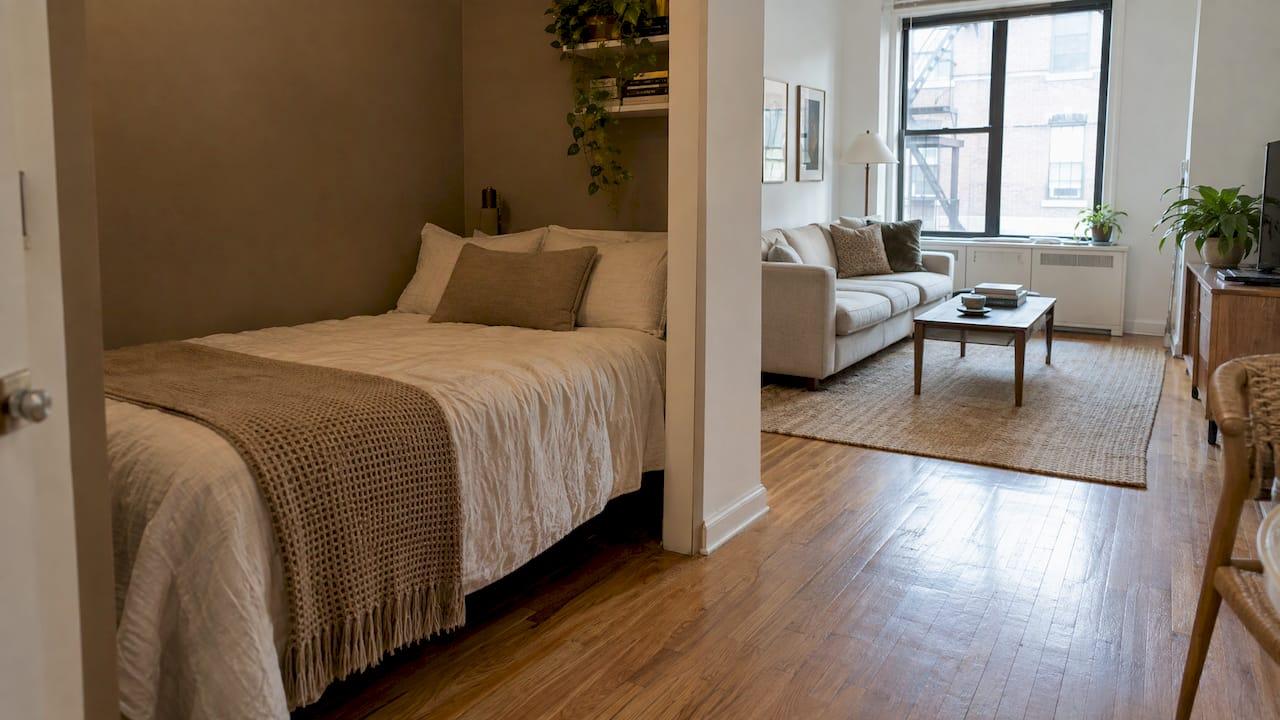
An alcove studio is a studio apartment with a recessed nook off the main room, usually big enough for a bed, so you sleep in a partly separate space instead of in the middle of the living area. It is not a one-bedroom, and in New York it is not a legal bedroom either. A junior four is a different layout: a true one-bedroom plus an extra room or nook. If you are weighing either one to buy, we can walk you through how a specific floor plan will live, and how the building’s rules affect it.
TL;DR
- An alcove studio is one main room plus a recessed sleeping nook. It offers more privacy than an open studio, for less than a one-bedroom.
- A junior four is a one-bedroom with an additional nook or half room, often a dining alcove. The “four” counts living room, kitchen, bedroom and the nook.
- In NYC, a legal bedroom needs minimum dimensions and a window, so an alcove usually cannot be advertised as a bedroom.
- Before buying, check the nook’s real dimensions, light, walk-through paths, and whether the building (especially a co-op) lets you add a partition.
Table of Contents
- What does “alcove” mean in an apartment?
- Studio, alcove studio, junior four, one-bedroom: the differences
- What is a junior four?
- Does an alcove count as a legal bedroom in NYC?
- Why people choose an alcove studio
- What to watch for
- What to check before you buy or rent an alcove studio or junior four
- Alcove studio or junior four: which fits you?
- Our perspective
- Buying or selling an alcove studio or junior four
- FAQ
- Sources
What does “alcove” mean in an apartment?
In plain terms, an alcove is a recess: a section of a room that sits back from the main space. In a studio, the alcove is typically the part of the L-shaped or T-shaped floor plan where the bed goes. One media explainer describes alcove studios as studios with a little extra, with a section carved out of the main room for a bed, whether it is open or separated.
The shape varies a lot from building to building:
- L-shaped: the main room turns a corner, and the bed sits around the bend, out of sight from the front door.
- Recessed nook: a wall pocket or niche, sometimes a former dining area, set a step back from the living space.
- End-of-room alcove: the room extends past a pair of walls or a column, creating a distinct zone at the far end.
- Partitioned alcove: the nook has a sliding door, pocket door or curtain track, so it can be closed off.
The common thread is partial separation. You get a defined place to sleep, but the space is still part of one open plan with shared air, light and sound.
Studio, alcove studio, junior four, one-bedroom: the differences
Listings use these names loosely, so it helps to know the usual meaning of each.
| Layout | Sleeping area | Typical feel | Counted as a bedroom? |
|---|---|---|---|
| Open (standard) studio | Same room as the living area | One room plus kitchen and bath | No |
| Alcove studio | Recessed nook off the main room | One room with a defined sleeping zone | Usually no |
| Junior four | Separate bedroom, plus a nook or half room | One-bedroom with a flexible extra space | Bedroom yes; nook generally no |
| One-bedroom | Fully enclosed room with window and closet | Separate living room and bedroom | Yes |
The general definition of a studio apartment is a home where living and sleeping functions share a single room with no separate bedroom. An alcove studio sits one step up from that, because the sleeping space has some architectural definition. As the Apartment Therapy explainer notes, it still cannot be considered a one-bedroom when the sleeping area lacks a window and a closet, even if sliding doors make it feel like one.
Where the price lands
An alcove studio is bigger than a standard studio and smaller than a one-bedroom, so its price usually falls between the two. Buyers should treat that as a pattern, not a rule. The premium over an open studio in the same building depends on the line, the floor, the light and how usable the nook really is. That is why comparing comparable sales in the same building, rather than comparing layout names across the city, gives you the real number.
What is a junior four?
A junior four is a one-bedroom apartment with an extra small room or nook, commonly a dining alcove off the living room. The “four” is a room count in the old New York style: living room, kitchen, bedroom and the extra nook. Some older apartments are described as having a fourth “half room” that residents have turned into a second sleeping space or a home office.
This is what separates it from an alcove studio:
- The alcove studio has no enclosed bedroom. The nook is the sleeping area.
- The junior four already has a real bedroom. The extra nook is a bonus, used for dining, work, a nursery or a guest bed.
You will see junior fours most often in pre-war buildings, where layouts were designed around separate dining and living functions. If you want to understand how those older room counts work more broadly, our guide to the classic six apartment explains the same counting logic on a larger scale.
In New York, listings also use “junior one-bedroom” for alcove studios. That label is marketing language and does not change what the room is legally.
Does an alcove count as a legal bedroom in NYC?
In most cases, no. The rules for what can be marketed as a bedroom are specific, and an alcove often misses on size, a window, or both.
A New York real estate FAQ on how bedrooms and other rooms may be marketed gives the general benchmarks. A bedroom must be at least 80 square feet, with minimum dimensions of 8 by 8 by 8 feet, and 6 feet wide at its narrowest point. The same document says a bedroom needs a window opening to a street, a yard or a court on the same lot. The window area must equal at least one-tenth of the room’s floor area, and each required window must be at least 12 square feet.
That has practical consequences:
- A nook with no window is not a bedroom. It can still be a sleeping area, but a listing cannot honestly call it a bedroom.
- Size matters even with a window. A deep, narrow alcove can be under 80 square feet, or too narrow, even if it holds a queen bed.
- A glass partition or curtain does not change the classification. Adding a door or wall to an alcove changes how it feels, not how the code counts it.
We cover the full set of measurements, light and egress questions in our guide to what makes a legal bedroom in NYC. Read it before you assume a flex layout will count as an extra bedroom at resale, because lenders, appraisers and the next buyer will all look at the same facts.
Why people choose an alcove studio
The appeal is simple: you get a bit more of the things a one-bedroom offers without a one-bedroom price.
- Privacy. The biggest perk, per the Apartment Therapy piece, is your own section for sleeping rather than a bed out in the open. Guests do not see your bed from the front door.
- Zoning your day. A defined sleeping zone helps separate work, living and rest, which matters if you work from home.
- A middle step in price. It sits between a studio and a one-bedroom, which suits first-time buyers and pied-à-terre owners.
- Resale logic. Buyers who want a studio but dislike the sleep-in-the-living-room feel make up a steady pool for this layout.
What to watch for
The same explainer lists the common trade-offs: limited sunlight in the alcove, and layouts where you have to walk through the sleeping area to reach the bathroom, which can be awkward when guests visit. A broker quoted in that piece also notes that in pre-war buildings the alcove is sometimes labeled a dressing room, depending on where it sits relative to the bathroom.

These are layout questions you answer by standing in the space, which is why the checklist below matters.
What to check before you buy or rent an alcove studio or junior four
This is the walk-through we recommend, in the order we would do it.
1. Measure the nook, not the room
Total square footage can be misleading. Measure the alcove itself, at its narrowest point. A queen bed is about 5 feet wide and 6.7 feet long, so you also need room to walk around it and open drawers. If the nook is only slightly larger than the bed, plan on a smaller mattress or built-in storage.
2. Look at where the light comes from
Most alcoves sit away from the windows. Visit at two times of day if you can. A dark nook is fine for sleeping but less so if you plan to use it as an office. Lighting also solves part of the problem: a wall-mounted fixture at the right level frees up the bedside table, and guidance on bedside wall light height can help you plan reading light in a tight recess.
3. Trace the walking paths
Stand at the front door and walk to the bathroom, the kitchen and the closet. If any route runs through the sleeping zone, imagine it with a guest in the apartment. That one detail changes daily living more than the room count does.
4. Count closets
An alcove often has no dedicated closet, which is part of why it cannot be marketed as a bedroom. Check whether the apartment has a closet near the entry, and whether there is wall space for a wardrobe or built-ins.
5. Ask what you are allowed to build
Many owners want to add a partition, sliding door or curtain track. In a co-op or condo, any alteration usually needs written approval from the board or managing agent, and sometimes a licensed contractor and insurance. Ask for the alteration rules before you fall in love with a plan to wall off the nook. If you are weighing building types, our guides to buying a co-op and buying a condo explain how approval, monthly costs and flexibility differ.
6. Compare against the right comps
Value the apartment against recent sales of the same line in the same building, or against truly similar layouts nearby. Mixing alcove studios with open studios and junior fours in a search leads to a wrong price in either direction.
7. Think about the next buyer
Every layout you consider should pass a resale test: will the next buyer see this as a genuine alcove studio or junior four, or as an expensive studio that was marketed as more? A clear, honest layout sells faster than one that depends on a creative label.
Alcove studio or junior four: which fits you?
Choose an alcove studio if you live alone or as a couple, you want to keep the cost down, and you are comfortable with an open plan that has one defined sleeping zone.
Choose a junior four if you want a real bedroom with a door and a window, plus a flexible space for a desk, a dining table or a baby. Junior fours usually carry higher prices and, in a co-op, can mean higher monthly maintenance because of the added space.

If you are undecided, tour one of each in the same neighborhood on the same day. The difference in how the two feel at 6 p.m. is usually clearer than any floor plan.
Our perspective
Floor plans flatten a lot of detail. An alcove that looks generous on paper can lose half its usefulness to a radiator, a column or a door swing. A junior four that is described as a one-bedroom plus a den might have a den with no window.
As a former Upper West Side condo board president, I have seen how a building’s rules turn a layout from flexible to fixed. Whether you can add a partition, how an alteration gets approved, and how the board reads your financials matter as much as the square footage.
That is why we start with the building, then the line, then the nook. We want you to understand how the apartment will live and how it will resell before you make an offer, and we never want you rushed into a decision this size.
Michael Carroll
Buying or selling an alcove studio or junior four
These layouts reward careful representation. Michael J. Carroll is a licensed real estate salesperson with Brown Harris Stevens, based at 1934 Broadway on the Upper West Side, representing buyers and sellers of co-ops, condos and townhouses across Manhattan. For buyers, that means guidance from search to closing, including building-specific detail and board approval. For owners of a studio, alcove studio or junior four, the sell-side service covers pricing strategy and marketing, so the layout is described accurately and presented at its best.

If you are comparing specific listings, reach out through michaelcarrollnyc.com and we will go through the floor plans with you.
FAQ
Is an alcove studio the same as a junior one-bedroom?
Often the labels overlap, since New York listings sometimes market alcove studios as junior one-bedrooms. The label is marketing, not a legal category. What counts is whether the sleeping area meets the size and window rules for a bedroom, and most alcoves do not.
What does “junior four” mean?
A junior four is a one-bedroom apartment with an additional small room or nook, often a dining alcove off the living room. The “four” counts the living room, kitchen, bedroom and the extra space. Many owners use that fourth space as an office or a second sleeping area.
Can I turn an alcove into a bedroom?
You can often add a partition, sliding door or curtain to make the nook feel private. That does not make it a legal bedroom, which needs minimum dimensions and a qualifying window. In a co-op or condo, check the building’s alteration rules and get approval before any work.
Is an alcove studio a good buy?
It can be, when the nook is large enough to use comfortably, the building is well run, and the price reflects the layout in comparison with similar apartments in the same building. A broker who knows the building can help you test each of those before you make an offer.
Sources
- What Is an Alcove Studio and Why Would I Want One?
- Studio apartment
- Frequently asked questions concerning the proper marketing of bedrooms and other rooms
- Wall light height guide