A condo reserve fund is money a building sets aside for major repairs and replacements of shared parts, such as the roof, boilers and elevators. For a Manhattan buyer, the useful question is how healthy the fund is and what the building will ask of you at closing. In New York, no law sets a minimum for most existing condos, so you have to read the building’s numbers yourself, and a broker who has sat on a board can tell you which numbers matter.
TL;DR
- A reserve fund pays for big, predictable capital work on common elements, not day-to-day running costs.
- New York does not require reserve studies or a minimum balance for existing condos, so the balance, the budget line and the plan for big projects are your best evidence.
- Many NYC buildings charge a one-time buyer payment at closing, usually called a working capital or capital contribution. Confirm the amount before you sign.
- Lenders are tightening condo rules around reserves. Fannie Mae’s required reserve contribution is scheduled to rise from 10% to 15% of assessment income on January 4, 2027, which can affect financing.
- A thin reserve usually shows up as higher common charges or a special assessment later. Read the financials before you make an offer.
Table of Contents
- What a condo reserve fund is and what it pays for
- What New York law requires, and what it leaves to you
- How much is enough: the reserve study
- Why lenders care: the 2026 and 2027 rule changes
- What the reserve tells you about a Manhattan building
- Resale fees, working capital and flip taxes in NYC
- How buildings invest their reserves
- A buyer’s checklist for reserves
- Our perspective
- Working with us on a Manhattan condo purchase or sale
- FAQ
- Sources
What a condo reserve fund is and what it pays for
Think of the building’s money in two buckets. The operating budget pays for the routine: the super’s payroll, cleaning, utilities, insurance and regular elevator servicing. The reserve fund is a separate savings account for large projects that are expected to arrive eventually.
Official guidance from Canadian regulators describes the same split. Ontario’s condo regulator describes a reserve fund as long-term savings for repairing or replacing common elements: roofs, HVAC systems, parking lot repaving, pools and similar amenities. It is not for routine maintenance. The principle is the same in a Manhattan condo, even though the legal framework differs.
Typical reserve-fund items in a New York building include:
- Roof replacement and roof repair and maintenance
- Facade and window work, including repointing and waterproofing
- Boilers, heating and cooling plants, pumps and major plumbing risers
- Electrical systems
- Elevator modernization (as opposed to routine servicing, which sits in the operating budget)
- Shared amenities such as a gym or roof deck
What you own inside your apartment, such as your kitchen, bathroom fixtures and finishes, is your responsibility and does not come out of the reserve.
What New York law requires, and what it leaves to you
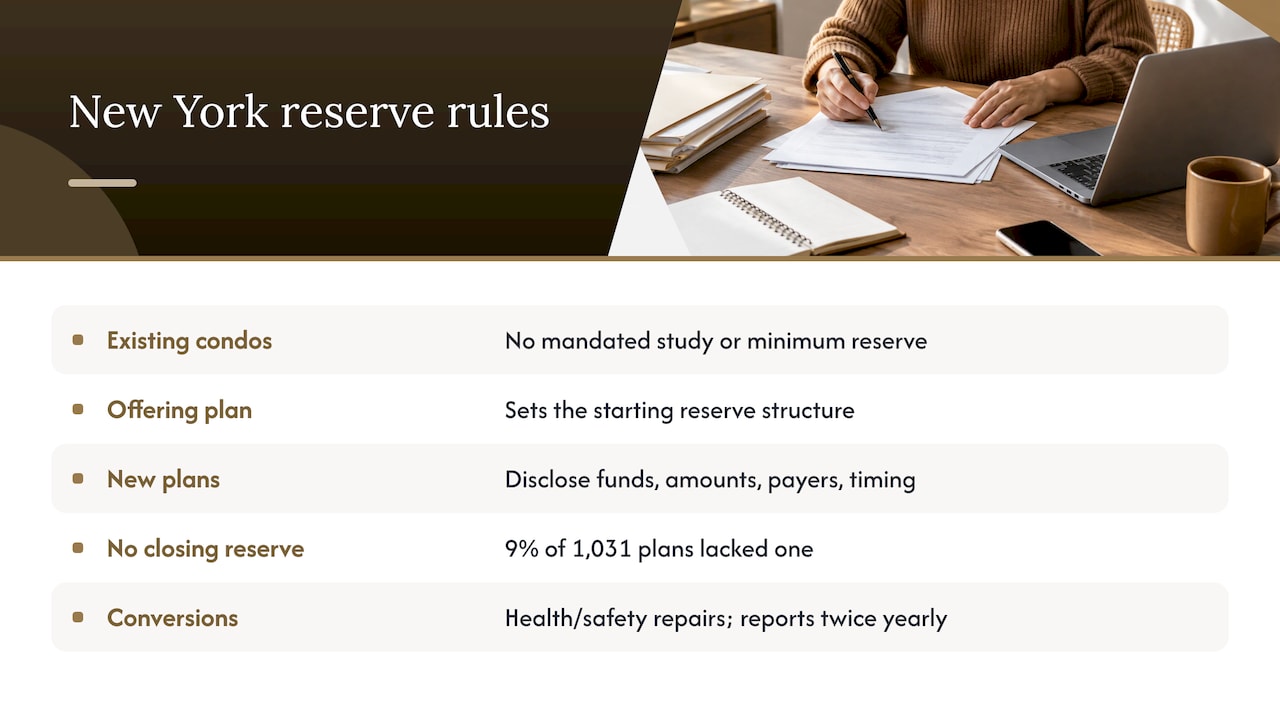
This is where Manhattan differs from many places. SmartProperty’s New York summary notes that New York law does not mandate reserve studies or a minimum reserve balance for existing condos. A building’s starting reserve structure is set out in its offering plan, and some plans say plainly that there is no special advance reserve fund.
A condo’s offering plan is the disclosure document the sponsor files for the sale of units. The New York Attorney General’s office reviews offering plans for compliance with state regulations, and every plan includes detailed information on the physical aspects of the building. It is the first place to look for how the reserve was meant to start.
In new condo plans, the details are specific. Under the Attorney General’s rules, as summarized by CondoBookNYC, a plan must state in separate sections whether there is a reserve fund and a working capital fund, how much each holds, who pays in and when the board receives it. The same review found that in 9% of 1,031 NYC condo plans with a reserve line, the plan says no reserve fund is set up at closing. In those buildings, the board builds the reserve through monthly charges over time.
For older buildings that went through a conversion, the rules are narrower. One review of New York’s administrative code says the conversion reserve fund is limited to capital repairs and replacements needed for residents’ health and safety, with semi-annual reporting to owners on deposits and withdrawals.
The practical result: in most Manhattan condos, the board decides how much to save. Some boards save diligently. Others keep common charges low and rely on special assessments when a big bill arrives.
How much is enough: the reserve study
There is no single correct dollar figure. The right amount depends on what the building contains, how old each system is and how much each will cost to replace.
The standard tool is a reserve study, a report from a specialist that inventories the building’s major components, estimates when each will need replacement and what it will cost, and recommends a funding plan. The Community Associations Institute’s reserve study standards describe adequate funding as reserves plus a multiyear plan that pays for major projects without supplemental funding. They describe three funding goals: baseline, threshold and full (close to 100% funded). Baseline is not recommended as a long-term approach.
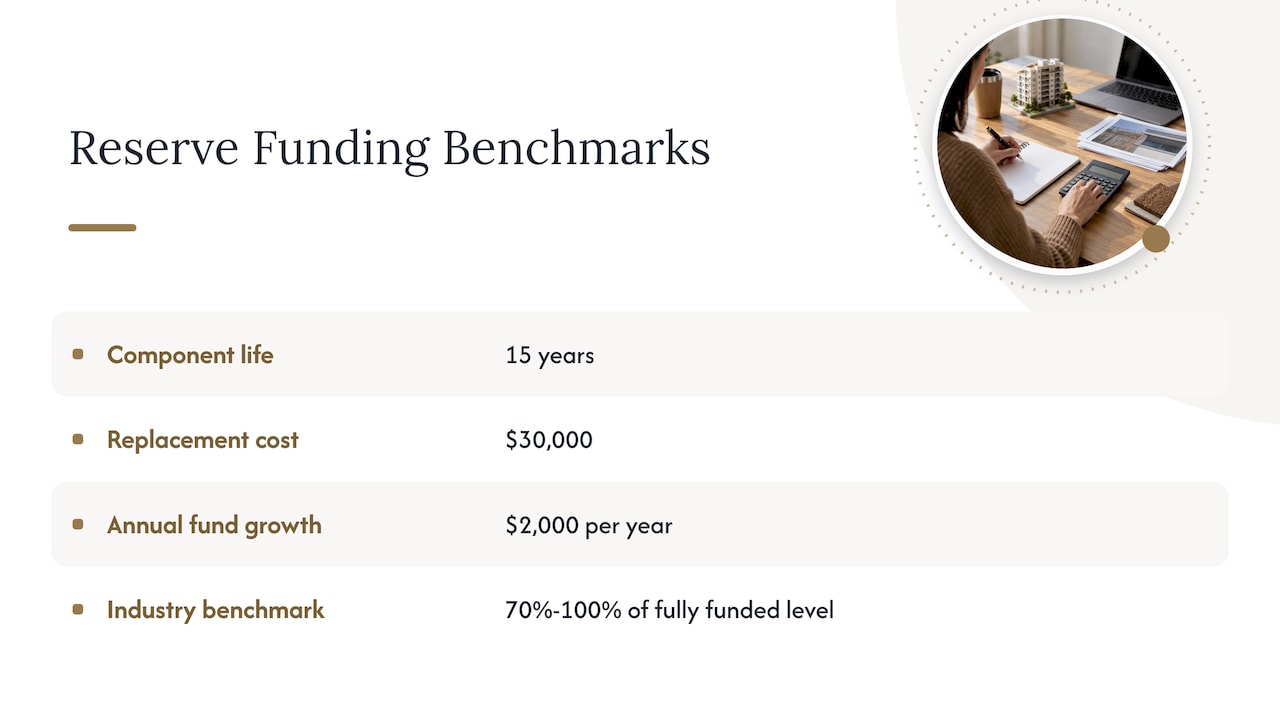
The arithmetic behind a study is simple. A Michigan condo attorney gives this example: a component with a 15-year life that costs $30,000 to replace means the fund should grow by $2,000 per year. Now multiply that across a roof, a facade, a boiler and a set of elevators, and the building’s annual need becomes clear.
You may see a rule of thumb that reserves should sit between 70% and 100% of the fully funded level. Treat it as a general benchmark from the condo industry, not a New York requirement. What matters in a specific building is whether the board has a current study, whether the budget follows it and whether the big-ticket items are already funded.
Why lenders care: the 2026 and 2027 rule changes
If you plan to finance, the reserve fund is not only a quality question. It can decide whether your mortgage is available on standard terms.
Per a March 2026 summary of Fannie Mae Lender Letter LL-2026-03, as of August 3, 2026, lenders that use a reserve study in place of the budget test must verify the project’s budget includes the highest recommended reserve allocation in the study. On January 4, 2027, the required reserve contribution is scheduled to rise from 10% to 15% of total assessment income, unless an up-to-date reserve study (within three years) is followed at its highest recommended funding level.
What this means for a buyer: a building that underfunds its reserves can be harder to finance conventionally. A condo that does not meet agency standards is often called non-warrantable, and there are several ways to finance a non-warrantable condo in Manhattan. It is far better to learn this before you are in contract than at the mortgage commitment stage.
What the reserve tells you about a Manhattan building
A reserve balance on its own is just a number. The meaning comes from putting it next to three other facts.
The age of the major systems. A $1 million reserve looks comfortable until you learn the facade is due for work and the quote is far larger. Ask when the roof, boiler, windows, risers and elevators were last replaced and what the board expects next.
The monthly charges. Unusually low common charges can mean a board is under-saving. Higher charges in a building with a healthy reserve can be the better deal over a few years, because you are paying for repairs in small installments rather than in a lump sum.
The history of assessments. A building that has levied special assessments recently may have fixed its biggest problems. One that has avoided them while deferring work may be due. Our guide to condo special assessments in NYC explains how to read this history.
To find these answers, work through the documents: the offering plan and any amendments, the last two or three years of audited financial statements, the current budget and 12 months of board minutes. Our walkthrough on reading a building’s financial statements shows which lines to find first, and minutes often reveal planned projects before the financials do. A condo inspection covers your unit and what is visible, but it does not tell you the state of the building’s savings, which is why the document review matters.
Resale fees, working capital and flip taxes in NYC
People searching for a “condo resale fee” in New York usually mean one of a few different charges. Because the terms overlap, ask the managing agent or your attorney to name exactly what applies in a given building.
| Charge | Who typically pays | What it is |
|---|---|---|
| Working capital or capital contribution | Buyer | A one-time payment into the building’s accounts at closing, often stated as a number of months of common charges or a flat amount |
| Flip tax | Usually the seller, where a building has one | A building-imposed fee on sale that goes to the building. It is more common in co-ops than condos |
| Managing agent and move-in fees | Typically the buyer | Administrative charges and deposits set by the building |
The working capital contribution is the one most tied to reserves. Its purpose is to add to the building’s cash so the new owner starts out contributing to the building’s upkeep. For new developments, the offering plan states the amount. For resales, it is set by the building and shown in the buyer’s closing documents, so ask early. We cover this in detail in four closing checks on the working capital contribution, and our closing cost guide puts it alongside the mansion tax, mortgage recording tax and title charges.
There is one more cost difference worth knowing. Condo buyers who finance pay the mortgage recording tax, which co-op buyers generally avoid. We compare the two in cooperative vs. condo closing costs in Manhattan.
How buildings invest their reserves
A reserve fund usually sits in conservative holdings. In New York, there is no legal requirement on reserves outside conversions, so the board decides. A CooperatorNews article on protecting reserves reports that buildings typically use bonds, Treasury bills or money-market accounts, and quotes a CPA who advises keeping two to three months of working capital in liquid instruments.
When you review the financials, look at where the money is held and whether the interest income is shown as a line item. It tells you the board is managing the fund deliberately.
A buyer’s checklist for reserves
Bring these questions to your attorney and to us before you make an offer.
- Is there a current reserve study? If so, how old is it and does the budget follow its recommended funding?
- What is the reserve balance, and how has it moved over three years? A steadily growing balance with major projects completed is a good sign.
- What capital projects are planned in the next five years? Facade, roof, boiler and elevator work lead the list.
- Have there been special assessments, and is another discussed in the minutes?
- What do you pay at closing? Working capital, move-in deposit and any other building charge.
- Will your lender approve the building? Ask early, especially with the 2027 reserve contribution change ahead.
Our perspective
Thirty years in this market, and time as an Upper West Side condo board president, taught us the same lesson: the reserve fund is a record of how a board thinks. When we sit on the board side, we see how hard it is to ask owners for more in common charges, and how tempting it is to defer. That is why we read a building’s reserves as a story rather than a number.
Our approach for buyers is to look at what the board has done, not what it says. We read the financials and the minutes with you, line by line, and tell you plainly what we see. Our priority is that you never feel rushed. A purchase this size deserves time.
For sellers, a well-funded reserve is an asset worth presenting. We help you organize the building’s financial story so buyers and their lenders see it clearly.
Michael Carroll
Working with us on a Manhattan condo purchase or sale
Michael J. Carroll is a licensed real estate salesperson with Brown Harris Stevens, based at 1934 Broadway on the Upper West Side, representing buyers and sellers of co-ops, condos and townhouses across Manhattan. If you are weighing condos, we go through the building’s financials, reserves, assessments and closing costs with you before you make an offer. Start with buying an apartment, or read how buying a condo in NYC works from offer to closing.
If you own a unit and are thinking of selling, see how we approach selling your apartment.

FAQ
What is a condo reserve fund used for?
It pays for major, predictable repairs and replacements of common elements: roofs, facades, boilers, elevators and similar systems. It does not cover routine operating costs, which come from the regular budget, or repairs inside your own unit.
Does New York require condos to have a reserve fund?
For most existing condos, no. New York law does not mandate a reserve study or a minimum balance. The offering plan describes how the reserve starts, and the board decides how much to save afterward.
Do I pay into the reserve fund as a condo owner?
Indirectly, yes. Boards fund reserves through common charges, and many buildings also collect a working capital contribution from buyers at closing. Some boards fund the reserve at the start through the sponsor in new developments, as the offering plan states.
What happens if the reserve fund runs short?
The board can raise common charges or levy a special assessment on owners. Alberta’s official guidance, for example, notes that a board may require a special levy when the fund is short. In New York, reading the minutes and financials beforehand shows how likely that is.
Sources
- Introduction to Reserve Funds: What They Are and What They Cover (CMRAO)
- New York Reserve Study Laws vs. a Board’s Fiduciary Duty (SmartProperty)
- Before You Buy a Co-op or Condo (New York Attorney General)
- NYC Condo Reserve Funds: How Much New Buildings Set Aside (CondoBookNYC)
- 100+ Regulatory Gaps in NYC Condo & Co-op Law
- Reserve Study Standards (CAI, July 2023)
- The Role and Importance of the Reserve Study (Heron, 2016)
- REBA: Updates to the FNMA and FLMC Condominium Guidelines
- Prudent Investing Is Key: Protecting Your Reserve Funds (CooperatorNews)
- Reserve funds (Alberta.ca)
- Roof repair services